
What is being tested
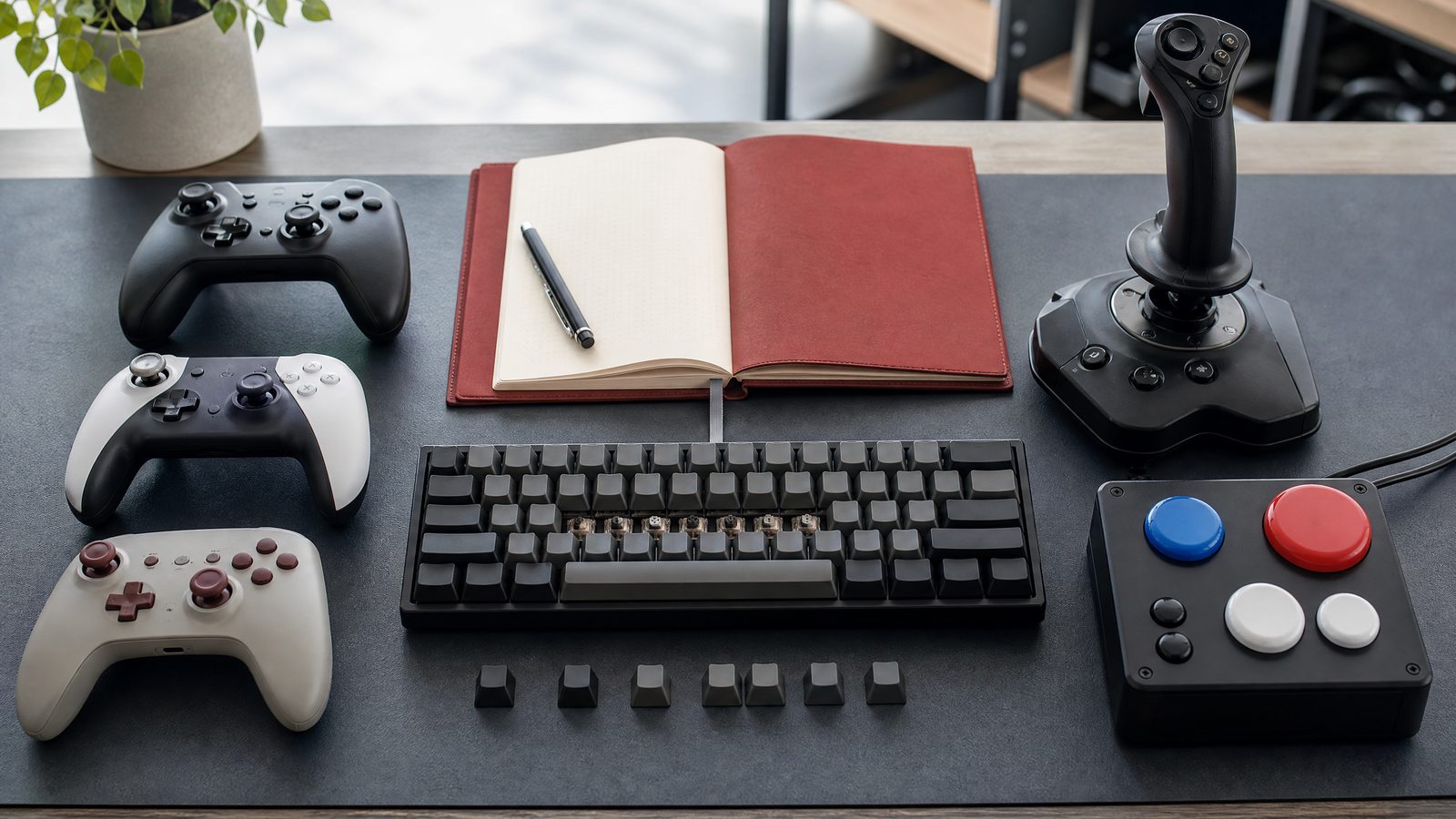
The bench uses a commercially available adaptive switch interface that presents itself to the system as a standard game controller. Nothing about it is exotic: to the operating system it looks like a pad with a small number of digital inputs and one axis.
Detection is tested before mapping. The question is not whether the game plays well with the device — it is whether the game acknowledges that the device exists, lists it as an input source, and allows an action to be assigned to it.
The four outcomes
| Outcome | Games | Share |
|---|---|---|
| Full support — detected, all actions assignable | 72 | 34% |
| Partial — detected, some actions unreachable | 68 | 32% |
| Needs translation layer — only via external software | 26 | 12% |
| Not detected — device never enumerated | 46 | 22% |
The partial category is the largest source of practical frustration. In those sixty-eight games the device works, the player configures it, and then somewhere in the third hour an action appears that requires two simultaneous digital presses and cannot be rebound. Splinter Arena is the clean example: movement and attacks assign perfectly, then the dash and throw escape turn out to be unreachable.
Why detection fails
In every one of the forty-six non-detecting cases the device is visible to the operating system and functional in other software at the same moment. The failure is inside the game, and it takes three recognisable forms.
The most common is a hard-coded list of accepted controller identifiers, which rejects anything unfamiliar rather than falling back to a generic profile. The second is an input layer that requires a specific number of axes to be present. The third, and the least defensible, is a settings screen that enumerates devices only once at launch and never again, so anything connected afterwards is invisible until the game is restarted — and in eleven cases, not even then.
An allow-list of controller identifiers is a decision to exclude every device the developer had not personally seen. It is almost always cheaper to accept anything the system reports and let the player sort out the mapping.
The three failure patterns, with counts
- Hard-coded controller allow-list — 29 games.
- Minimum axis-count requirement in the input layer — 12 games.
- Devices enumerated once at launch and never re-scanned — 5 games.
What the storefront says
Nothing. Of the forty-six games that cannot see the device, none carry any indication of the limitation on their store pages, and thirty-one carry a generic "controller supported" marker that is technically true and practically misleading.
This is the reason the survey exists in this form. A player who needs this hardware currently has no way to learn whether a game will work except to buy it and find out, and the refund window is frequently shorter than the point at which an unreachable action appears.
The good cases
Seventy-two games get it completely right, and the pattern among them is dull and consistent. They accept any device the system reports, they offer a generic fallback profile, they re-scan when hardware is connected, and they permit every action to be assigned.
Banner Plateau goes one step further by shipping a profile designed for single-input hardware, which is the only such profile recorded in bench twenty-six. Red Pillars reaches the same practical result with three bindings and no special provision at all, which suggests the simplest route to good device support is to need less from the device.
The one that fails worst
Wet Circuit is the most instructive failure in the current bench, because its analogue input modelling is the best here by a wide margin. Somebody on that team cared deeply about input. The switch box still does not appear in the menu, which tells you the care was aimed at the hardware on their own desks and stopped there.
What we ask for
Accept any device the operating system reports. Provide a generic fallback profile. Re-scan on connection. Permit every action to be assigned. All four are cheaper than the allow-list most games ship instead, and together they would move forty-six titles out of the worst category in this survey.