The game, briefly
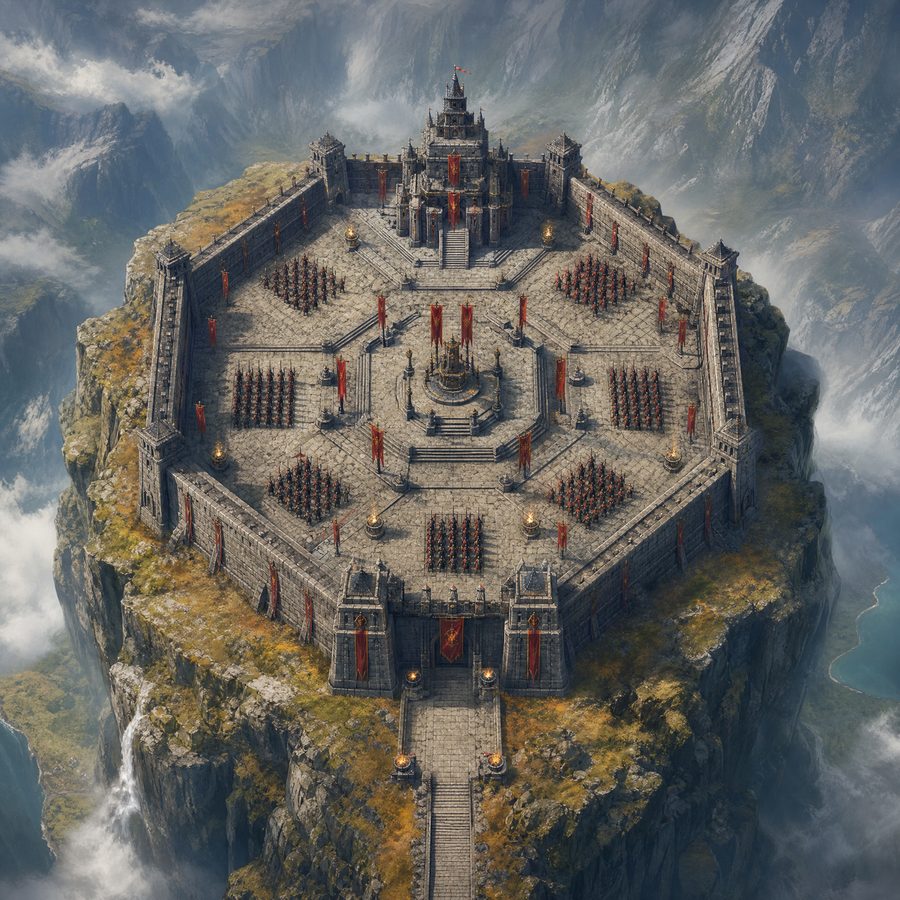
A turn-based strategy game about holding a single fortified plateau against seasonal pressure, with supply, morale and terrain doing most of the work and combat resolving in a way you can predict two turns ahead. It is unhurried, legible, and slightly too easy after the first campaign.
From an input perspective it is the least eventful game in the archive, and it is included precisely for that reason: it demonstrates what a control scheme looks like when nothing about it can fail.
Input count
Eighteen bound actions and a peak simultaneous demand of one. There is no state in the game where two inputs must overlap, no timing window shorter than the player's patience, and no sustained hold of any kind. Everything is a discrete selection.
This is not an accessibility feature bolted on afterwards; it falls out of the design. A turn-based game with no real-time layer has no reason to require overlapping inputs, and this one takes that freedom seriously instead of adding shortcuts that quietly reintroduce chords.
| Measure | Banner Plateau | Bench 26 median |
|---|---|---|
| Bound actions | 18 | 19 |
| Peak simultaneous | 1 | 4.5 |
| Sustained holds | 0 | 2.5 |
| Chords or double-taps | 0 | 3 |
| Timing windows under 200 ms | 0 | 2 |
The rebinding audit
One hundred per cent, and unusually the game ships a keyboard-only profile, a pad profile and a single-input profile intended for assistive hardware. That third profile is the only one of its kind in this bench, and it works: every action is reachable through sequential selection with no overlap required.
The menu also does something small and correct — it displays the number of inputs required for each action, so a player can see at a glance that nothing exceeds one. No other game in the archive shows this, and it took whoever built that screen an afternoon.
A one-input peak is not always available to a designer. When it is, taking it produces a game that four different kinds of hands play identically, which is a result no accessibility menu can retrofit.
Across four devices
Identical. Full functionality on pad, keyboard, switch box and — absurdly but truthfully — the flight stick, since a single selection input can come from anywhere. This is the only row of results in bench twenty-six with no qualification attached to any entry.
| Device | Playable | Actions unavailable |
|---|---|---|
| Keyboard and mouse | Fully | None |
| Standard pad | Fully | None |
| Adaptive switch box | Fully | None |
| Flight stick | Fully | None |
Where it loses points
The second campaign reuses the first campaign's pressure curve almost exactly, the morale system stops mattering once you understand it, and there is no difficulty setting between comfortable and punishing. Seven point six is a fair score for a solid strategy game with a thin back half.
It is worth stating plainly that the input result did not raise the score. A perfect control scheme is the expected condition, not a bonus; what the bench records is how rarely the expected condition is met.
Verdict
The least interesting bench in twenty-six iterations and the only one where every cell of the device table says the same thing. If you want to know what "finished" looks like at the input layer, it looks like this, and it did not require the game to be simple — only to avoid asking for things it did not need.