The game, briefly
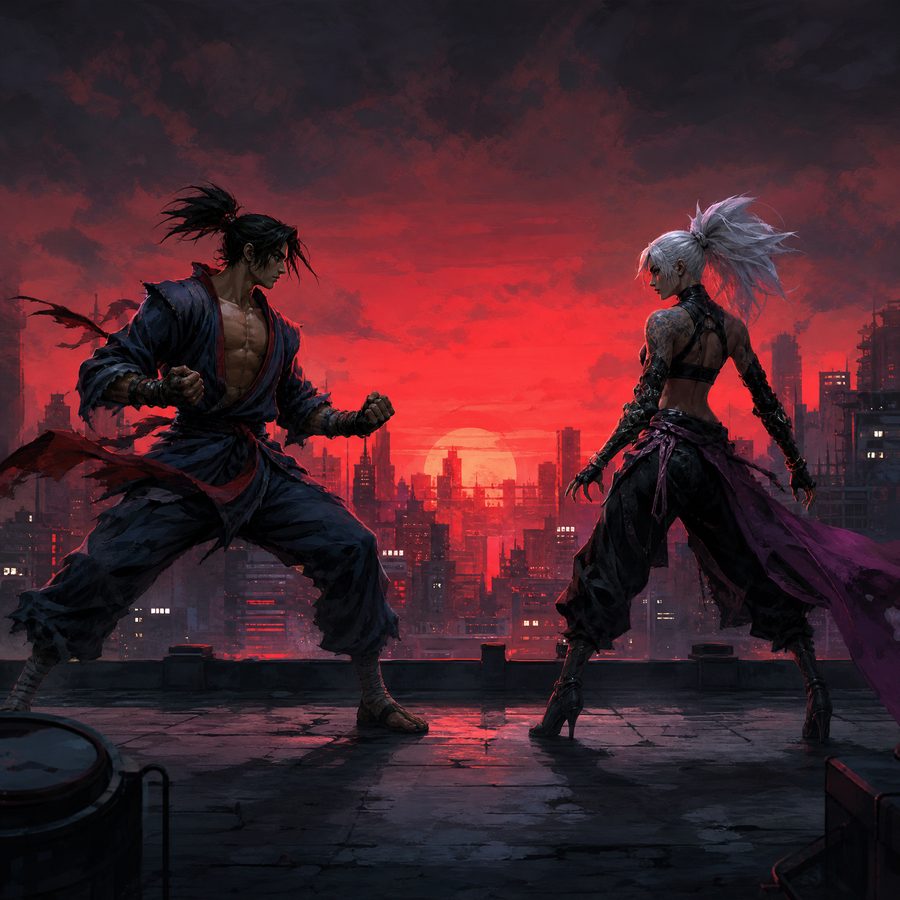
Splinter Arena is a four-button fighter with a parry system that rewards reading an opponent rather than memorising strings, and a movement game good enough that high-level matches are legible to someone who has never played it. As a fighting game it is the best thing in this bench and one of the better things in the archive.
What follows is not a complaint about difficulty. Fighting games are allowed to be hard, and this one is hard in interesting ways. It is a complaint about the fact that its difficulty is delivered through a physical arrangement that cannot be changed.
Input count
Twenty-two distinct bound actions. Peak simultaneous demand is nine, recorded during the extended parry-cancel sequences that the game's own tutorial teaches at chapter four. Nine is the highest figure in twenty-six benches and the second-highest in the archive.
Peak demand alone is not damning — a game can ask for nine inputs briefly and remain comfortable. The problem here is duration. The nine-input state is not a one-frame flourish; it is the shape of a competitive exchange, sustained for two to four seconds at a time, dozens of times a match.
| Measure | Splinter Arena | Bench 26 median |
|---|---|---|
| Bound actions | 22 | 19 |
| Peak simultaneous | 9 | 4.5 |
| Sustained holds | 5 | 2.5 |
| Holds with toggle option | 0 | 1 |
| Timing windows under 200 ms | 6 | 2 |
The rebinding audit
Forty-four per cent of actions can be reassigned in the menu. The remaining fifty-six per cent cannot, and the four that matter most are named here because a percentage hides what is actually lost.
Parry is fixed to a shoulder button. Cancel is fixed to a second shoulder button. The dash input is fixed to a double-tap of the movement axis with no button alternative. And the throw escape is fixed to a simultaneous press of two face buttons, which is the single input in this bench that most testers failed to perform reliably.
A locked binding is not a difficulty setting. It is a statement that the developer has decided which hands the game is for, and has done so accidentally, in a menu nobody revisited.
What is actually locked
- Parry — fixed shoulder button, no alternative offered.
- Cancel — fixed second shoulder button, frequently required within 120 ms of parry.
- Dash — double-tap on the movement axis, cannot be assigned to a button.
- Throw escape — simultaneous two-button press, no chord remapping and no single-button option.
Across four devices
On a standard pad the scheme works as designed and is genuinely satisfying once learned. On keyboard and mouse it becomes noticeably better, because the fixed shoulder buttons become adjacent keys and the two-button throw escape becomes trivial — an accident of hardware rather than any accommodation by the game.
On a flight stick it is meaningless and was not pursued beyond confirming the game accepts the device. On an adaptive switch box it is close to unplayable: the box is detected and can drive movement and the four attack buttons, but the fixed chord and double-tap inputs cannot be expressed, which removes the throw escape and the dash from the game entirely.
| Device | Playable | Actions unavailable |
|---|---|---|
| Standard pad | Yes, as designed | None |
| Keyboard and mouse | Yes, easier than pad | None |
| Flight stick | Detected, not sensible | Most of the scheme |
| Adaptive switch box | Partially | Dash, throw escape |
What two days of work would have fixed
Every problem listed above is a menu problem rather than a design problem. The parry and cancel could be reassignable without changing a frame of the fighting. The dash could accept a button as an alternative to the double-tap, as Red Pillars does. The throw escape could offer a single-button option, as roughly a third of the archive already does.
The fighting system would be untouched by all three changes. The difficulty would be untouched. The only thing that would change is the number of people who can reach it, and the honest version of the score below reflects that gap rather than any flaw in the combat.
Verdict
Seven point nine. As a fighting game it is comfortably an eight and a half; as a piece of software it loses that difference to four bindings nobody thought about. If you have played fighters for years on a pad, ignore the deductions and buy it. If your hands need the scheme to move, this one will not move, and no patch has been announced that changes that.